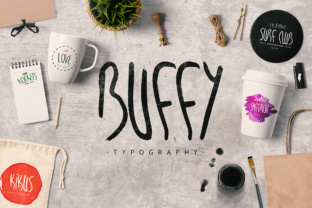
Buffy: A Fluid, Wobbly Display Font That Balances Personality with Readability
Choosing a display typeface often means deciding between expressive character and clear legibility. Many fonts lean heavily into one at the expense of the other. Buffy stands apart as a fluid, wobbly display font that manages to deliver both visual interest and functional readability. It occupies a specific niche: playful enough to grab attention, but constructed carefully enough to serve real communication needs. For professionals evaluating typefaces for branding, marketing materials, or digital content, Buffy deserves a closer look.
What Makes Buffy Worth Noticing
Buffy is not a neutral, quiet font. Its defining trait is a deliberate wobble—an organic, hand-drawn quality that makes each letterform feel slightly irregular. This is not a flaw; it is the core design feature. The fluidity gives the typeface a sense of movement and warmth, as if each character were painted or penned rather than mechanically constructed. Despite this fluidity, the letters remain fun and readable. The designer avoided excessive distortion, ensuring that ascenders, descenders, and counters stay within recognizable proportions.
What sets Buffy apart from many novelty display fonts is its restraint. The wobble is present but controlled. Letterforms maintain their essential shapes, so a reader does not have to guess which character they are looking at. This balance makes Buffy usable in contexts where pure decorative fonts would fail. It offers personality without sacrificing the basic contract between designer and audience: that text should be understood quickly and comfortably.
Key Characteristics and Practical Strengths
Several characteristics define Buffy and explain its practical value:
- Fluid construction. The strokes have a natural, almost liquid quality. Curves are soft, and straight lines carry a subtle organic bend. This gives the font a friendly, approachable feel.
- Consistent wobble. The irregularity is distributed across the character set, so no single letter feels out of place. The rhythm of the wobble is consistent, which helps maintain visual harmony in blocks of text.
- Readable letterforms. Despite the playful design, each glyph is clearly distinguishable. Lowercase 'a' and 'e' remain open, 'b' and 'd' are not confused, and terminal strokes are clear. This is not a font that hides its letters in stylistic flourishes.
- Good x-height. The lowercase letters are proportionally tall relative to the capitals, a trait that improves readability at smaller display sizes.
- Generous spacing. Default letter spacing is comfortable, preventing the wobble from causing collisions or crowding. This is a thoughtful design choice that reduces the need for manual kerning adjustments in most applications.
These traits mean Buffy works well as a display face for headlines, titles, pull quotes, and short promotional text. It is less suited for long body copy, but that is not its purpose. As a display font, it fulfills its role with consistency.
How Buffy Performs in Real-World Applications
In practice, Buffy performs best when given room to breathe. On posters, social media graphics, website headers, and product packaging, the wobble becomes a visual signature. It conveys a sense of handmade authenticity that can be difficult to achieve with more polished, geometric typefaces.
One realistic example: a small bakery using Buffy for its storefront signage and Instagram posts. The font's fluid, wobbly feel aligns with artisanal branding, suggesting fresh ingredients and careful handcrafting. The readability ensures that the name of the bakery and its daily specials are clear at a glance, even at mobile screen sizes.
Another scenario: a freelance illustrator or designer using Buffy for a personal portfolio site. The font can set the tone for a creative practice that values imperfection and warmth. It works especially well when paired with a clean, neutral secondary typeface for body text, creating a contrast that highlights the personality of the display font.
However, there are contexts where Buffy may not be the best choice. For formal corporate communications, legal documents, or any setting where absolute neutrality is required, the wobble would feel out of place. Similarly, for very small text sizes—below 24 points in digital use—the fluidity can begin to obscure legibility. The font is designed for impact, not for subtlety at small scales.
Quality, Usability, and Long-Term Value
From a quality standpoint, Buffy shows careful attention to technical execution. Glyph outlines are clean, with smooth bezier curves that scale well across print and digital media. The font file includes a reasonable set of standard characters, punctuation, and numerals, making it functional for most design projects. Some versions may offer multilingual support or stylistic alternates, depending on the foundry and license.
Usability is strong for a display font. The generous default spacing and consistent x-height reduce the time spent on manual adjustments. Designers familiar with standard typographic workflows will find Buffy straightforward to implement. It works in web projects via @font-face or standard desktop applications, and its performance remains reliable across modern browsers and operating systems.
Long-term value depends on how well the font fits your brand or creative voice. Buffy is not a trend-driven novelty; its hand-drawn quality is timeless in the same way that hand-lettering has enduring appeal. If your work values organic, human-centered aesthetics, Buffy will remain useful for years. If your brand identity shifts toward a more rigid or minimalist style, the font may feel dated in that context. This is true of any distinctive typeface—its value is tied to its alignment with a consistent visual identity.
Who Benefits Most from Buffy and When
Buffy is not a one-size-fits-all solution, but several groups will find it especially useful:
- Small business owners in creative, food, lifestyle, or retail sectors who want storefront signage, menus, or packaging with a handcrafted feel.
- Freelance designers and illustrators looking for a distinctive display font to anchor their own branding or client projects that call for warmth and playfulness.
- Marketers and content creators producing social media graphics, email headers, or ad creative that needs to stand out in crowded feeds while remaining readable.
- Bloggers and publishers in lifestyle, design, or culture niches who want article titles and section headers to convey personality without confusing readers.
- Educators and serious hobbyists creating posters, zines, or presentation materials where approachability and visual interest matter more than strict formality.
The font is best applied at medium to large display sizes—typically 36 points and above in print, or equivalent sizes in digital layouts. It shines in short-form text where each word carries weight: product names, event titles, taglines, and quote callouts.
Practical Recommendations and Possible Limitations
If you are considering Buffy for a project, here are practical recommendations based on real use:
- Pair it with a clean sans-serif or neutral serif for body text. This creates contrast and lets Buffy take the starring role without overwhelming the layout.
- Avoid using it for long paragraphs or dense information. Its strength is in short bursts. For any text longer than two or three lines, switch to a more readable companion font.
- Test at target size early. Display fonts behave differently at different scales. Make sure the wobble reads as intentional rather than sloppy at your intended size.
- Consider color and background. Buffy works well on solid, light backgrounds. Busy patterns or low-contrast backgrounds can diminish its readability, so keep surroundings simple.
- Check spacing in all caps. If you plan to use Buffy in all-caps settings, preview the letter combinations. Some display fonts need minor kerning adjustments for uppercase sequences, and Buffy may require a little attention here.
Possible limitations are worth noting. Buffy is not highly versatile across diverse contexts—it does one thing well, and that is deliberate. It will not replace a comprehensive type family. If your project requires a single font for headings, subheadings, body text, and captions, Buffy is not the right choice. Additionally, availability may vary by foundry. Some versions may have limited character sets, so verify support for your specific language or symbol needs before purchasing or licensing.
A Balanced View of Buffy's Place in Your Toolkit
Buffy earns its place as a useful resource for designers and communicators who need a display font with genuine character. It is not a workhorse for every task, but it does not claim to be. Its fluid, wobbly design is a deliberate choice that brings warmth, approachability, and a sense of craft to the right projects. The fact that it remains readable while being playful is its strongest asset—proof that personality and usability are not mutually exclusive.
When evaluating Buffy for your own work, consider the context, audience, and purpose of your project. If the goal is to inject humanity and a lighthearted tone into a headline or brand element, Buffy is a solid option worth testing. If the need is for neutrality, precision, or broad versatility, look elsewhere. Understanding this distinction is what separates effective type selection from arbitrary decoration. Buffy knows what it is, and that clarity makes it valuable in the hands of professionals who know what they need.
Whether you are a small business owner designing your first storefront sign, a marketer refreshing a campaign visual, or a freelancer building a cohesive brand identity, Buffy offers a genuine alternative to the usual display font choices. It invites you to consider what your text might look like if it had a little more life, a little more wobble, and a little less stiffness. For many projects, that is exactly the right direction.