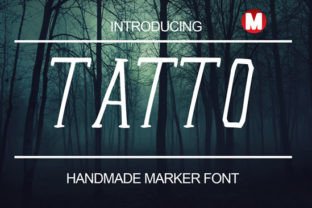
Tatto: A Handmade Marker Font That Fits Your Process
When you are building a project—whether it is a wedding invitation suite, a set of social media quote cards, or a small business identity—the typeface you choose often sets the emotional tone before a single word is read. Tatto is a modern handmade marker font designed to bring that raw, personal feel into a wide range of creative and professional workflows. Unlike sterile, mechanical fonts, Tatto carries the irregular strokes, slight weight variations, and organic energy of real marker pen lettering. This makes it a practical asset for anyone who needs to communicate authenticity without sacrificing clarity.
Tatto fits naturally into projects where a human touch matters. It works for invitations, greeting cards, branding materials, business cards, quotes, posters, and more. But understanding how to integrate it smoothly into your own routine—from planning through final output—makes the difference between a font that feels like an afterthought and one that elevates the entire piece.
What Makes Tatto Different from Other Marker Fonts
Many marker-style fonts try to simulate handwriting but end up looking too uniform or digitized. Tatto is drawn from real marker strokes, which means each character has natural variation in thickness, angle, and roughness. This handmade quality gives it a distinct personality that works well for projects intended to feel approachable, creative, or handcrafted.
From a workflow perspective, the key advantage is that Tatto delivers that handmade look without requiring you to actually hand-letter anything. You can apply it to a layout in minutes, then adjust size, tracking, and color to fit the context. Because the font is designed with multiple alternates and ligatures (if the version includes OpenType features), you can avoid the repetitive look that sometimes plagues script fonts. In practice, this means a poster or business card will look like it was written by a human, not a machine.
Planning a Project That Uses Tatto
Before you open your design software, think about where Tatto will sit in the overall composition. For an invitation, Tatto might be the voice of the host—friendly and informal. For a branding project, it could convey a small-batch, artisan vibe. Ask yourself: Is the audience comfortable with a handmade aesthetic? Will the font work alongside other elements like logos, photography, or solid color blocks?
Preparation matters. Tatto works best when you have a clear idea of its role. Will it be the headline font? The only font? Paired with a clean sans-serif for contrast? I have seen projects where Tatto is used for the main message and then supported by a lightweight sans like Montserrat or Open Sans for addresses and fine print. That combination gives you the warmth of handwriting with the readability of a neutral typeface. Plan this pairing during the concept stage, not as an afterthought.
Another planning step is testing readability at different sizes. Tatto’s marker strokes are legible at medium to large sizes, but for small text (under 12–14 points) the charm can turn into a blur. If your project includes small captions or disclaimers, consider a companion font for those parts.
Integrating Tatto into Your Design Workflow
Once you have a plan, the next phase is execution. Tatto integrates with most design tools—Adobe Illustrator, Photoshop, InDesign, Affinity, Canva, and even Word or Google Docs for simpler projects. Install the font file (usually OTF or TTF) and you can start typing immediately. Because it is a marker font, you will want to pay attention to leading and letter-spacing. Tatto’s characters have extended strokes that can collide if spacing is too tight. I usually set tracking slightly looser than default, especially for all-caps words or lengthy headlines.
In a typical workflow, I place Tatto text over a background that suggests handcrafted materials—like textured paper, fabric, or a subtle grunge texture. The font interacts with those backgrounds by looking like it was drawn on the surface, not pasted on. If you are working on a digital product (social media graphics, website headers, video titles), consider adding a slight drop shadow or a multiply blend mode to integrate the letters with the background. This quick technique gives the text a physical presence.
Tatto also works well in layered compositions. For example, a poster might have a large Tatto word as the focal point, with a smaller sans-serif caption overlaid. Because Tatto has high stroke contrast, it holds up against busy backgrounds when you choose a color that contrasts well. Dark red on cream, black on kraft paper, or white on dark charcoal are reliable combinations.
Invitations and Greeting Cards
For personal or event stationery, Tatto can replace expensive hand lettering. Use it for the main event phrase (e.g., “Join Us” or “Save the Date”) and pair with a simple serif or sans for the details. Because the font is handmade, it naturally suits vintage, rustic, or modern casual themes. For a cohesive look, match the ink color to the dominant color in your envelope or ribbon.
Branding and Business Cards
Small businesses that want to emphasize a bespoke, local, or creative identity can use Tatto in their logo or tagline. On business cards, limit Tatto to the name or a short line, and use a clean font for contact information. This prevents the card from looking too messy. For branding consistency, create a style guide that specifies Tatto’s usage—size ranges, color palette, and what it should never be used for (e.g., long paragraphs).
Quotes and Posters
Tatto excels in quote graphics and posters because it draws attention. When typing a long quote, break it into short lines and adjust line breaks manually—automatic justification rarely works well with marker fonts. I often use varying sizes for emphasis, making key words larger or in a different color. The irregular strokes add movement, so a poster that uses Tatto for the headline and a regular font for attribution feels dynamic without being chaotic.
After the Design: Production and Quality Control
Once the design is finalized, review how Tatto behaves in the final medium. For print, check that small text remains legible. If the font file includes OpenType alternates, ensure your software is using them (most modern Adobe tools enable contextual alternates by default). Print a test sample at actual size to catch any unexpected overlaps or spacing issues. Tatto’s strokes are relatively thick, so you can sometimes decrease the font weight slightly if the printer adds ink spread. For digital output (PDF, images, web), export at high resolution so the marker texture is preserved.
If you are sending files to a client or printer, outline the text or include the font file if permitted. Many print shops prefer outlined text to avoid font substitution. For web use, convert Tatto to SVG or use it as an image—it is not a standard web font at the time of writing, so embedding is not always an option.
Long-Term Use and Consistency
Tatto is a distinctive font, and that is its strength and its limitation. Using it sparingly in a brand system gives you flexibility: you can switch to a more neutral font for functional text while keeping the personality for headlines. Over a series of projects, maintain consistency by documenting where Tatto appears. A simple one-page brand guide that says “Tatto for headings only, never below 18px, paired with Lato Regular” keeps the visual identity tight.
For freelancers and creators who work on multiple projects, organize your font library so that Tatto is easy to find and test. Use a font manager like FontBase or rightFont to preview it against other fonts before committing. This organization saves time when you are juggling tight deadlines.
Observations on Efficiency and Organization
Integrating Tatto into a routine is straightforward if you treat it like any other creative tool—not a magic solution. I have found that the best results come from planning the font choice before writing copy. Because marker fonts can feel playful, they can undermine a serious message if used carelessly. By deciding upfront that Tatto is right for the project’s tone, you avoid redoing layouts later.
When working with clients or team members, explain why Tatto was chosen. A brief rationale (“Tatto suggests the handmade quality of your product, and we paired it with a clean sans for readability”) helps align expectations. This kind of clarity belongs in the early stages of any workflow.
For educators and bloggers, Tatto can make digital content feel more personal. Use it for lesson titles or blog post headers—it breaks up the monotony of system fonts. In video projects, animated Tatto text can mimic hand-lettering if you add a wiggle effect. The key is using the font purposefully, not as decoration.
Ultimately, Tatto is a modern handmade marker font that fits into real processes because it solves a specific problem: how to add authentic, handcrafted character without spending hours hand-lettering. With careful planning, thoughtful pairing, and attention to size and context, it becomes a reliable part of your toolkit—whether you are designing a wedding suite, a brand identity, or a simple quote poster.