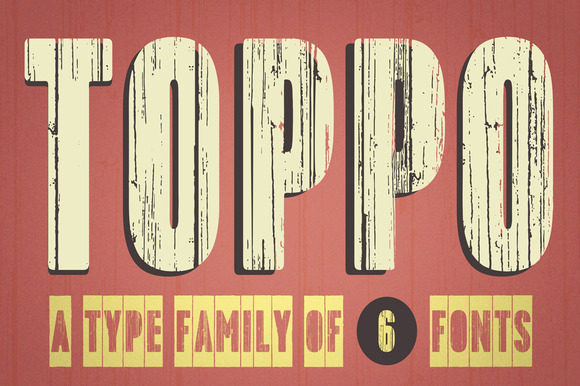
Toppo Font: A Small Family with Big Personality for Real Design Work
If you spend any time browsing typefaces, you know the feeling: another sans-serif, another geometric option, another family that looks fine but leaves you cold. Then you stumble onto something like Toppo, and suddenly you are paying attention. Designed by Blazej Ostoja Lniski from the Typoforge foundry, Toppo is a compact font family that draws its inspiration from a Polish magazine called You and Me, published from May 1960 to December 1973 by RSW Prasa. That mid-century editorial energy gives this typeface a distinctive voice — one that works in surprisingly practical ways today.
So what exactly is Toppo? It is a small but thoughtfully built family that includes Toppo Regular, Toppo Stencil, Toppo Frame, Toppo Negative, Toppo Stencil Frame, and Toppo Stencil Negative. Each variant brings something different to the table, and together they offer a toolkit that is greater than the sum of its parts. But rather than listing specs, let us talk about where this font actually shines and why you might want to reach for it on your next project.
Editorial and Magazine Layouts
Given its origin story, it is no surprise that Toppo feels completely natural in editorial work. That vintage Polish magazine inspiration is not just a trivia fact — it shows up in the proportions, the rhythm, and the way the letterforms sit on a page. If you are designing a small-run zine, a culture blog, or even a print publication that wants to nod to mid-century modernism without looking like a museum piece, Toppo Regular is a strong candidate.
I have seen designers use Toppo for pull quotes and section headings in arts publications, and the results are striking. The Regular weight carries enough character to hold attention without screaming for it. Pair it with a reliable serif for body text, and you get a spread that feels intentional rather than assembled from default options.
Posters and Event Flyers
Toppo Stencil and Toppo Frame are where this family starts to show its range. Imagine you are putting together a poster for a film screening, a gig, or a community event. You want something that reads clearly from a distance but also has a bit of texture. Toppo Stencil gives you that cut-out, industrial feel without going full military stencil. It is crisp and direct, but the shapes retain enough warmth to avoid feeling harsh.
Toppo Frame, on the other hand, is a clever tool for creating bordered effects or secondary text that surrounds a central image. I have watched a colleague use Toppo Frame to build a series of event posters where the frame variant acted as a structural element — almost like a physical border around the composition. It saved hours of manual outlining and gave the whole series a cohesive identity.
Branding for Small Businesses and Creative Studios
Small business owners and freelancers often face a dilemma: they want a custom look but do not have the budget for a bespoke typeface. Toppo offers a middle ground. Because the family includes multiple stylistic variants under one roof, you can build a consistent brand system using a single font family. Use Toppo Regular for your logo, Toppo Negative for reversed-out applications like white text on dark backgrounds, and Toppo Stencil for secondary marks or packaging details.
A friend of mine runs a small ceramic studio and used Toppo across her packaging, website headers, and studio signage. The consistency made her brand feel polished, and the distinctive shapes helped her stand out on a shelf full of hand-lettered, rustic competitors. Toppo is not rustic — it has a clean, considered edge that works well for modern craft brands, design studios, coffee shops, and creative services.
Graphic Designers and Art Directors
For professionals, Toppo is a problem-solver. Need a headline face that works both in print and on screen? Toppo Regular holds up well at various sizes. Working on a project that demands multiple text treatments but you only want to license one family? The six variants give you flexibility without the overhead of managing a dozen different fonts. The Stencil Negative and Stencil Frame options are particularly useful for posters and social media graphics where you want layered effects without complicated masking.
Small Business Owners and Entrepreneurs
If you are running a business and handling your own design work, you do not have time to learn the nuances of a sprawling font superfamily. Toppo is manageable. Four core styles (plus the stencil and frame variations) are easy to understand and apply. You can use it for your logo, your website headings, your flyers, and your social media templates. The consistency builds recognition, and the unique look helps you avoid the cookie-cutter feel of free fonts.
Publishers and Content Creators
Anyone producing digital or print content — newsletters, blogs, magazines, reports — will appreciate how Toppo performs in headlines and display roles. It has a personality that works for opinion pieces, cultural commentary, and lifestyle content. The Negative variant is especially useful for video thumbnails and social media cards where text sits over images.
Practical Considerations Before You Use Toppo
No font is perfect for everything, and Toppo has its own sweet spot. Here are a few things to keep in mind.
It is a display face, not a body text workhorse. Toppo shines at larger sizes: headlines, titles, pull quotes, posters, and branding elements. If you try to set long paragraphs in Toppo Regular, readability will suffer, especially at small sizes. The letterforms have personality, and that personality needs room to breathe. For body text, pair it with a neutral serif or a straightforward sans-serif that does not compete.
The Stencil and Frame variants are specialized tools. Toppo Stencil Frame and Toppo Stencil Negative are fantastic for specific use cases, but they are not everyday workhorses. Use them when you need a particular effect — a cut-out look, a bordered headline, a reversed treatment — rather than forcing them into every project. They are best applied with intention.
Licensing and availability. Toppo comes from Typoforge, a boutique foundry. That means it may not be included in large font subscription services. You will likely need to purchase a license for commercial use. For a small family, the cost is reasonable, but it is worth factoring into your project budget. Check the licensing terms carefully, especially if you plan to use it in client work or digital products.
Language support. Toppo covers most Latin-based European languages, but if you need extended Cyrillic, Greek, or non-Latin scripts, you will need to look elsewhere. The character set is sufficient for English, Polish, French, German, Spanish, and similar languages, but it is not a global typeface.
Strengths That Stand Out
- Cohesion across variants. Because all six styles share a common DNA, mixing them in a single project feels natural rather than chaotic. This is rare in small families.
- Mid-century character without nostalgia. Toppo is inspired by a vintage magazine, but it does not feel dated. It carries that editorial confidence into contemporary contexts.
- Efficiency for branding. One family can cover logo, headlines, secondary text, and accent treatments. That saves time, money, and decision fatigue.
- Great for layered compositions. The Frame and Negative variants make it easy to build depth in posters, covers, and digital graphics without complex software tricks.
Limitations to Keep in Mind
- Not a full-featured superfamily. If you need multiple weights, italics, or condensed/expanded versions, Toppo will not deliver. It is intentionally small and focused.
- Limited body text use. This is a display typeface. For long-form reading, you will need a companion font.
- Specialized variants require thoughtful use. Stencil and Frame styles are not universal. Overusing them can make a project feel gimmicky rather than distinctive.
- Smaller foundry support. Typoforge offers quality design, but update cycles and customer support may not match larger foundries. It is worth downloading the trial versions to test thoroughly before committing.
Final Thoughts on Toppo
Toppo is one of those typefaces that feels like it was made for specific kinds of projects — the ones where you want the text to say something beyond the words themselves. It carries a slight editorial swagger, a nod to Polish magazine design from the 1960s and 70s, but it translates that heritage into a clean, usable tool for today.
If you are designing a cultural publication, building a brand for a creative business, or putting together event materials that need to stand out without trying too hard, Toppo is worth a close look. It is not the font for every job. But for the jobs it fits, it fits beautifully.
And honestly, that is the mark of a good typeface. Not trying to be everything, but being exactly what a certain project needs. Toppo understands that. It might be exactly what you need too.