Bedesau: An Experimental Display Typeface Rooted in Art Nouveau Tradition
When searching for a typeface that carries both historical resonance and a distinctly modern experimental edge, few options capture the eye quite like Bedesau. This display font draws its primary inspiration from the Art Nouveau movement, yet it refrains from being a mere revivalist piece. Instead, Bedesau reinterprets the flowing, organic lines of the late 19th and early 20th centuries through a contemporary lens, resulting in a typeface that feels both familiar and unexpectedly fresh. For designers, marketers, and content creators evaluating typographic choices, understanding where Bedesau fits within the broader landscape of display fonts is essential for making an informed decision.
Understanding Bedesau: Origins and Distinct Characteristics
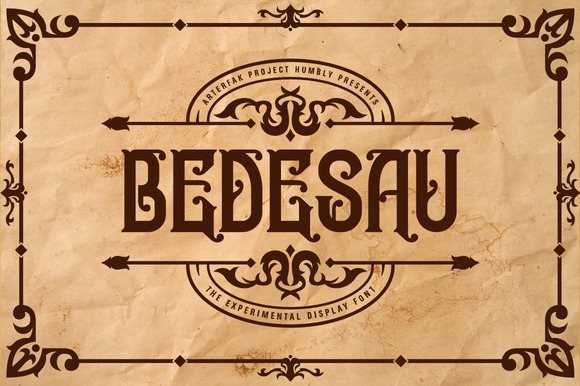
Bedesau is not a conventional serif or sans-serif typeface. It belongs to the category of experimental display fonts, meaning its primary purpose is to command attention and convey a specific mood or aesthetic rather than to blend into the background. The Art Nouveau influence is immediately apparent in its sinuous curves, asymmetrical shapes, and the way letterforms seem to grow organically from one stroke to the next. However, unlike strict period reproductions, Bedesau introduces subtle distortions, uneven weights, and unexpected angles that give it a handmade, almost imperfect quality.
This tension between historical reference and contemporary experimentation is what sets Bedesau apart. The typeface does not try to hide its influences, but it also does not limit itself to them. The result is a font that works well for projects where you want to evoke a sense of craftsmanship, natural forms, or artistic rebellion without falling into cliché. The letter spacing tends to be generous, and the contrast between thick and thin strokes is pronounced, making each character feel like a small piece of illustrative art.
For those evaluating Bedesau, it is important to recognize that this is not a text face designed for long-form reading. Its experimental nature means that legibility can be compromised at smaller sizes, especially in dense paragraphs. Instead, its strengths lie in settings where each letter can breathe and where the audience has time to appreciate the details.
Comparing Bedesau with Other Display Typeface Styles
When placing Bedesau alongside other display typeface categories, several clear distinctions emerge. Traditional Art Nouveau revival fonts, such as those based on the work of Alphonse Mucha or Hector Guimard, tend to be more uniform and decorative. They often feature floral motifs, swirling stems, and highly ornamental capitals. Bedesau, by contrast, strips away much of the overt decoration and focuses on the underlying structure of the forms. It is more abstract and gestural, which makes it feel less like a costume and more like a contemporary interpretation.
Compared with geometric sans-serif display fonts, Bedesau is far more expressive. Geometric faces rely on mathematical precision and uniformity, whereas Bedesau embraces irregularity. If your project calls for clean, minimalist modernity, a geometric sans would likely be a better fit. Bedesau, on the other hand, suits projects where warmth, humanity, and a sense of organic flow are desired.
Another common comparator is the category of script or handwritten display fonts. While Bedesau shares some cursive qualities, it does not attempt to mimic handwriting. Its letterforms are more constructed and deliberate, with a clear typographic structure beneath the fluidity. This makes it more versatile than many script fonts, which can be difficult to pair with other typefaces or to use in all-caps settings. Bedesau performs well in both uppercase and lowercase, though the lowercase forms often display the most character.
Finally, compared with other experimental or deconstructivist typefaces, Bedesau is relatively restrained. It does not distort letters to the point of illegibility, nor does it rely on extreme angles or fragmentation. This balance between experimentation and readability is one of its key strengths, especially for designers who want to push boundaries without alienating their audience.
Strengths and Best-Fit Applications for Bedesau
Bedesau shines in contexts where visual impact and mood are paramount. Posters, album covers, book covers, and branding materials for creative industries are natural homes for this typeface. Its Art Nouveau roots make it particularly effective for projects related to art, fashion, interior design, craft beverages, boutique hotels, or any brand that wants to communicate a sense of refined artistry with a touch of the unconventional.
In logo design, Bedesau can be used to create a distinctive wordmark that feels handcrafted and memorable. The uneven strokes and organic forms suggest a human touch, which can be valuable for brands that emphasize artisanal processes or personalized service. However, it is worth noting that the font’s distinctiveness means it may not suit every industry. Corporate law firms, financial institutions, or technology startups with a minimalist brand identity would likely find Bedesau too expressive for their needs.
For editorial design, Bedesau works well as a headline or subhead font, particularly in layouts that feature ample white space and large imagery. It can also be effective in pull quotes or introductory drop caps, where its decorative qualities can be appreciated without overwhelming the reader. When used in body text, it is best reserved for very short passages—perhaps a few lines of introductory copy or a tagline—where the audience can engage with the typography as part of the visual experience.
In digital contexts, Bedesau is suitable for hero headers, landing page titles, and promotional banners. Its irregular forms can add personality to an otherwise clean web layout. However, designers should test it carefully at various screen sizes and resolutions, as the subtle details that make Bedesau appealing may be lost on small mobile screens or low-resolution displays.
Tradeoffs and Limitations to Consider
No typeface is without its tradeoffs, and Bedesau is no exception. The most significant limitation is legibility at small sizes. Because the strokes vary widely in thickness and the letterforms are not always uniform, reading extended text in Bedesau can be fatiguing. For body copy, a complementary sans-serif or serif font should be paired with it to ensure readability. The designer must also be mindful of letter spacing, as Bedesau’s organic shapes can cause certain letter pairs to feel too tight or too loose depending on the context.
Another consideration is the typeface’s strong personality. While this is a strength in many applications, it also means that Bedesau can overpower other elements in a design. It works best when given room to breathe and when paired with simpler, more neutral typefaces. A cluttered layout with multiple competing visual elements will diminish the impact of Bedesau. Similarly, using it in all-caps for extended text can be challenging, as the uppercase forms may not flow as naturally as the lowercase.
Versatility is another factor. Bedesau is not a workhorse typeface that can be used across an entire brand identity without careful consideration. It is a specialty font, best deployed strategically rather than as a default choice. Organizations with a diverse range of communication materials may find that Bedesau suits only a subset of their needs. For example, it may work beautifully on a product label but feel out of place in a corporate brochure or annual report.
Finally, availability and licensing should be considered. Depending on where you obtain Bedesau, the font may come with restrictions on commercial use, embedding in digital products, or modification. Always review the license terms carefully before committing to a project, and ensure that the version you are using is from a reputable source.
Practical Comparison Scenarios: Where Bedesau Excels and Where It Doesn’t
To make the evaluation more concrete, consider a few realistic scenarios. Imagine a boutique winery launching a new label for a premium red wine. The brand wants to convey tradition, craftsmanship, and a sense of natural elegance. In this context, Bedesau could be an excellent choice for the main label typography. Its Art Nouveau influences evoke a sense of heritage, while its experimental edges suggest a modern, small-batch approach. Paired with a clean serif for the back label text, the overall effect would likely feel cohesive and distinctive.
Now consider a tech startup developing a project management app. The target audience is corporate professionals, and the brand identity emphasizes efficiency, clarity, and innovation. In this scenario, Bedesau would probably be a poor fit. Its organic, ornamental qualities contradict the sleek, data-driven image the startup needs to project. A geometric sans-serif or a neutral grotesque would serve the brand far better, allowing the interface to feel clean and accessible.
Another scenario: a small art gallery organizing an exhibition of contemporary sculpture. The promotional poster needs to attract attention while conveying a sense of artistic exploration and physical form. Bedesau could be used effectively for the exhibition title and artist names, especially if the poster uses negative space and high-contrast photography. The font’s sculptural quality echoes the work on display. However, for the event details—date, time, location—a simpler typeface should be used to ensure legibility at a distance.
For editorial use, such as a feature article in a design magazine, Bedesau might serve as an impactful drop cap or section header. It adds visual interest without overwhelming the text. But if the article runs several thousand words and uses Bedesau for subheads throughout, readers may find the repetition tiring. In this case, alternating between Bedesau and a complementary sans-serif for different levels of headings would provide variety while maintaining visual harmony.
Decision Factors for Choosing Bedesau
When deciding whether Bedesau is the right typeface for your project, several factors should guide your choice. Start by considering the overall tone you want to achieve. If your brand or project values creativity, artistry, and a human touch, Bedesau can help communicate that. If the priority is precision, authority, or neutrality, a different typeface category will likely serve better.
Next, evaluate the context in which the typeface will be used. Is it primarily for print or digital? Large format or small? Short text or long passages? Bedesau performs best in short, prominent applications where its details can be appreciated. For extended text, plan to pair it with a more neutral font. Also consider the viewing distance and medium: a poster seen from several feet away can accommodate more experimental letterforms than a mobile screen held inches from the eyes.
Audience expectations also play a role. A younger, design-savvy audience may appreciate the bold expressiveness of Bedesau, while a more conservative audience may find it distracting or difficult to read. Knowing your audience’s preferences and reading habits can help you decide whether the tradeoff between impact and legibility is worth making.
Finally, consider the practical aspects of implementation. Test Bedesau in your specific design environment, whether that is a web mockup, a print layout, or a logo sketch. Pay attention to kerning, spacing, and how the font interacts with other elements. If possible, obtain a trial version or use a font testing tool before making a final commitment. A typeface that looks beautiful in isolation may behave differently in a crowded layout.
Final Considerations
Bedesau occupies a unique space in the world of display typography. It draws from the rich visual language of Art Nouveau without being bound by it, and it embraces experimentation without sacrificing readability entirely. For designers and brand owners who are evaluating their options, Bedesau offers a distinctive voice that can elevate projects with a creative, artisanal, or nature-inspired direction. However, it is not a universal solution. Its strengths are situational, and its limitations are real.
The most successful use of Bedesau comes from understanding its character and respecting its boundaries. By pairing it thoughtfully, applying it at appropriate sizes, and reserving it for contexts where its expressive qualities can shine, you can harness its potential without falling into common pitfalls. Like any tool, it is most effective when used with intention and awareness of the alternatives.
In the end, the decision to choose Bedesau should be based on how well it aligns with the message, audience, and medium of your specific project. By weighing the tradeoffs and comparing it against other display typeface styles, you can make a choice that feels right for your work rather than one driven by trend or impulse. Whether Bedesau becomes a staple in your typographic toolkit or a specialty item reserved for select projects, its distinctive blend of historical inspiration and modern experimentation makes it a worthwhile contender for any designer exploring the expressive potential of type.