Lazy Monk: A Deliberately Imperfect Font with Genuine Practical Value
Fonts are often designed with precision, consistency, and clarity in mind. Every curve, every weight adjustment, every kerning pair is crafted to produce a clean, predictable result. But not every project calls for perfection. Sometimes, you need something that looks human, flawed, and characterful. That is where Lazy Monk enters the picture. This typeface takes a different approach entirely, drawing inspiration from a playful historical premise: what if the medieval monks who painstakingly copied manuscripts by hand had been too lazy, or too drunk, to do a proper job?
The result is a font that looks deliberately uneven, slightly wobbly, and authentically hand-drawn. It is not a mistake. It is a deliberate design choice that serves specific creative and professional needs. This article examines what Lazy Monk actually is, what makes it worth considering, and where it fits into a serious designer's toolkit.
What Lazy Monk Actually Is
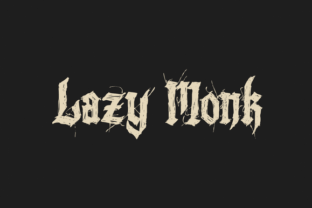
Lazy Monk is a display typeface that replicates the appearance of a handwritten medieval manuscript, but with a deliberately sloppy, inconsistent execution. The letters lean at slightly different angles, the strokes vary in thickness, and the spacing feels organic rather than mechanical. The font mimics the look of a scribe who was either too tired, too indifferent, or too inebriated to produce the clean, uniform script typically associated with monastic copying work.
Let me be clear: this is not a font you would use for a legal document, a corporate annual report, or a medical journal. It is not designed for body text at small sizes. Its purpose is entirely different. Lazy Monk is a display font, meant to be used at larger sizes where its irregular charm becomes an asset. The premise is humorous, but the execution is surprisingly refined. Every letterform has been carefully crafted to look careless, which requires real skill to pull off convincingly.
The font typically includes uppercase and lowercase letters, numerals, and basic punctuation. Some versions also include alternate characters or stylistic sets, though the core value lies in its overall attitude rather than in extensive glyph variation. What matters is the consistent inconsistency across the character set.
Key Characteristics and Design Philosophy
The defining feature of Lazy Monk is its deliberate lack of uniformity. In traditional manuscript fonts, you expect straight verticals, consistent baselines, and even spacing. Here, you get the opposite. Letters may sit slightly above or below the baseline. Ascenders and descenders vary in length. The pen pressure appears to change mid-stroke, producing thin and thick sections that feel spontaneous rather than planned.
This is not a font that tries to hide its flaws. Those flaws are the entire point. The design philosophy behind Lazy Monk embraces imperfection as a form of expression. When you use this typeface, you are telling your audience that you value authenticity, humor, and a human touch over sterile precision.
Another key characteristic is the texture. At display sizes, Lazy Monk creates a dense, tactile impression. The uneven strokes catch the eye and invite closer inspection. It feels like something you could reach out and touch, not like a digital rendering. This tactile quality is rare in modern typefaces and gives the font a distinct personality.
Strengths of the Design
- Strong personality: Lazy Monk immediately communicates a specific mood. It is playful, irreverent, and nostalgic without being sentimental.
- Versatility within limits: While not suited for every project, it works exceptionally well for headlines, posters, merchandise, and branding that needs a handcrafted feel.
- Historical resonance: The medieval inspiration adds depth. It connects your design to a real historical practice, even if the execution is deliberately exaggerated.
- Differentiation: In a world of polished sans-serifs and predictable scripts, Lazy Monk stands out. It helps your work avoid looking generic.
Practical Applications and Real-World Use
The real question for any serious professional is not whether a font is interesting, but whether it performs in actual projects. Lazy Monk has clear use cases where it excels, and equally clear ones where it should be avoided.
Where It Works Well
Lazy Monk is at its best in contexts where you want to evoke handmade authenticity, historical playfulness, or a deliberate lack of polish. Some of the most effective applications include:
- Event posters and flyers: Especially for music festivals, craft fairs, literary events, or themed parties. The font adds a rustic, hand-crafted energy that feels inviting.
- Product packaging: Small-batch artisanal goods, craft beverages, or handmade products benefit from a typeface that looks like it was written by hand. Lazy Monk suggests care and personality, not mass production.
- T-shirt and merchandise design: The irregular lettering works well on apparel, especially when combined with simple graphics. It has a conversational, almost inside-joke quality.
- Social media graphics: Used sparingly for headlines or callout quotes, it can break up the visual monotony of polished feeds.
- Editorial design: Some magazines and zines use Lazy Monk for section openers or pull quotes to create a distinctive visual identity.
- Branding for creative businesses: A brewery, a pottery studio, a letterpress shop, or a comedy club could all use this font as part of their visual language.
Where It Should Be Used with Caution
Lazy Monk is not suitable for body text, small sizes, or professional contexts that require clarity, authority, or readability. If you are designing a legal contract, a financial report, a medical brochure, or a government website, this font will undermine your message. It is also a poor choice for any project where the audience is expected to take the content completely seriously, unless the goal is deliberate humor or satire.
Additionally, the font may not perform well on low-resolution screens or at small sizes. The subtle variations in stroke thickness and spacing that give it character at large sizes can become messy and hard to read when scaled down. Stick to using it at 24 points or larger, and test it on actual devices before committing.
Quality, Usability, and Consistency
When evaluating a font like Lazy Monk, it is important to judge it by the right criteria. You cannot assess it the same way you would assess a professional text font like Helvetica or Garamond. The quality of Lazy Monk lies not in its uniformity, but in how convincingly it simulates irregular handwriting.
From a technical standpoint, the font is well-constructed. The letters are clearly legible at intended sizes. The kerning, while intentionally loose, does not create confusing overlaps or gaps. The baseline drift is controlled enough to look organic without becoming distracting. The characters maintain a consistent level of "messiness" across the entire set, which is harder to achieve than it sounds.
Usability is adequate for a display font. Most versions install easily on both Windows and macOS, and the font works with standard design software like Adobe Creative Suite, Affinity, and web-based tools. However, it may not include extensive OpenType features. If you rely on advanced typographic controls, check the specific version you are considering.
One limitation is the lack of multiple weights. Many display fonts offer at least regular and bold versions. Lazy Monk is often available in a single weight, which limits how much variety you can achieve within a single project. Combining it with a clean sans-serif or a simple serif font for body text is a practical workaround.
Who Benefits Most from Lazy Monk
This font is not for everyone, and that is fine. It serves a specific audience with specific needs. Based on my assessment, the people who will get the most value from Lazy Monk include:
- Graphic designers and illustrators: Anyone working on branding, posters, or packaging for creative clients will find this font a useful addition to their library. It provides a distinctive option that is hard to replicate with other typefaces.
- Small business owners: Entrepreneurs selling handmade or artisanal products can use Lazy Monk to create a cohesive visual identity that reflects the handcrafted nature of their goods. It helps communicate authenticity without spending heavily on custom lettering.
- Publishers and zine makers: Independent publishers looking for a font with personality and historical resonance will appreciate the medieval undertones. It works well for limited-edition prints, poetry collections, or experimental layouts.
- Event organizers: Whether it is a music festival, a craft market, or a literary salon, Lazy Monk adds a playful, unconventional energy to promotional materials.
- Educators and content creators: Teachers creating worksheets or digital content for history or art lessons might use this font to visually connect with the medieval manuscript theme. It adds a layer of contextual interest that plain fonts lack.
- Freelancers and creators: Anyone building a personal brand around creativity, humor, or craftsmanship can use Lazy Monk as a signature element in their design work.
Strengths and Limitations at a Glance
No font is perfect, and Lazy Monk is no exception. Here is an honest summary of what it does well and where it falls short.
Strengths
- Highly distinctive personality that sets designs apart
- Strong historical and thematic resonance
- Effective at communicating authenticity and handmade quality
- Versatile across multiple media when used appropriately
- Technically well-executed for its intended purpose
Limitations
- Not suitable for body text or small sizes
- Limited weight and style options
- May not include advanced OpenType features
- Performance on low-resolution screens can be poor
- Overuse or inappropriate use can feel gimmicky
Final Observations
Lazy Monk is a typeface that knows exactly what it is and does not pretend to be something else. It is not a workhorse font. It will not serve you well for long-form reading, professional correspondence, or high-stakes corporate design. But that is not its job. Its job is to add character, humor, and a sense of human imperfection to projects that benefit from those qualities.
If you are a designer or creator who values distinctiveness and has the judgment to use a display font only where it belongs, Lazy Monk deserves a place in your collection. It works best when paired with restraint. Use it for headlines, not paragraphs. Use it for accent, not foundation. When you treat it as a deliberate tool rather than a default choice, it can elevate your work in ways that more conventional fonts simply cannot.
The best fonts are not the ones that work everywhere. They are the ones that work exactly where they are meant to. Lazy Monk is, by design, a specialist. If your project calls for a touch of medieval mischief and hand-drawn warmth, it may be exactly the tool you need.