The Handwritten Soul of Design: Understanding the ‘Pretty’ Handmade Brush Font
In the vast landscape of digital typography, most fonts feel engineered. They are precise, mathematically perfect, and often sterile. A rare category breaks this mold entirely: the handmade brush font. These typefaces carry the warmth of human touch, the slight wobble of a wrist, and the texture of real ink on paper. Among them, ‘Pretty’ stands out not merely for its name but for its character. This is not a font that whispers; it invites. It is designed to feel like a personal note, a hand-painted sign, or a heartfelt invitation. Understanding why such a font matters requires more than a glance at its curves; it requires exploring how a single typeface can reshape a project’s emotional tone.
The Anatomy of a Handmade Impression
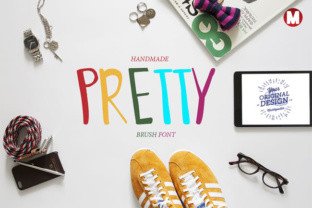
When we talk about a brush font, we are discussing more than just letter shapes. We are talking about pressure, angle, and rhythm. The ‘Pretty’ font embodies these qualities with deliberate imperfection. Each stroke mimics the natural flow of a brush dipped in ink—where the beginning of a letter is slightly heavier, the middle is fluid, and the tail tapers off with a flick. This inconsistency is not a flaw; it is the core of its appeal. In a world saturated with uniform sans-serif faces, a handmade brush font reintroduces variability. It makes every word look like it was written just for the reader.
Consider the lowercase ‘e’ in this typeface. Instead of a perfect oval, it has a slight openness, a loop that feels fast and natural. The uppercase ‘P’ begins with a thick, confident downward stroke that softens as it loops back. These details are not accidental. They are the result of careful design that aims to preserve the spontaneity of real handwriting. Designers who choose ‘Pretty’ are not just selecting a typeface; they are choosing to communicate through the illusion of immediate, personal expression.
Real-World Texture and Visual Warmth
One of the most undervalued characteristics of the handmade brush font is its ability to add texture to a flat digital space. In print, this is even more pronounced. When used on an invitation, the letters of ‘Pretty’ can evoke the feeling of calligraphy without the stiffness of traditional formal scripts. The edges are not razor-sharp; they have a natural fray that suggests a real brush was used. This texture makes branding materials feel approachable. A business card set in a clean, geometric font says “efficient.” The same card set in ‘Pretty’ says “creative and human.”
This warmth translates directly to readability in short, impactful contexts. While brush fonts are rarely ideal for lengthy body text, they excel at headlines, quotes, and short messages. The tactile quality of the letters captures attention quickly. A poster that uses ‘Pretty’ for a single word can communicate mood faster than a paragraph of explanation. This is the power of handmade typography: it bypasses the analytical brain and speaks directly to feeling.
Applications That Leverage the Handmade Feel
The versatility of a well-crafted brush font often surprises new users. While it is easy to pigeonhole ‘Pretty’ as only suitable for feminine or romantic projects, its actual range is broader. Its practical applications span multiple industries and media formats.
Invitations and Greeting Cards
This is the most intuitive use. Wedding invitations, birthday cards, and thank-you notes benefit immensely from a font that looks handwritten. Using ‘Pretty’ for the main headline of an invitation creates an immediate sense of intimacy. It suggests that the host took time to personally address each guest. When paired with a simpler sans-serif for logistical details like dates and addresses, the contrast is both readable and beautiful. The brush font becomes the emotional anchor, while the supporting text provides clarity.
Branding for Small Businesses and Creatives
Small brands, particularly those in artisanal sectors like baking, floral design, or handmade crafts, often struggle to convey authenticity. A logo or brand wordmark set in a handmade brush font can bridge that gap. ‘Pretty’ can be used within a logo as the central element, or as a supporting accent for taglines. A local coffee shop might use it on a chalkboard-style menu header. A wedding photographer could use it for watermarked portfolio images. The font communicates a level of care that stock photography and generic templates cannot match. It tells the customer that this business values artistry.
Social Media Graphics and Digital Quotes
Social media thrives on visual hooks. Platforms like Instagram and Pinterest reward content that stops the scroll. A motivational quote set in a clean, standard font often blends into the feed. The same quote set in ‘Pretty’ feels different—it looks like a personal affirmation written on a journal page. The slight irregularity in the letters makes the message feel genuine rather than manufactured. Content creators who regularly post quotes, affirmations, or short educational snippets find that using a handmade brush font increases engagement. It adds a layer of personality that an algorithm cannot replicate.
Physical Signage and Product Labels
For businesses that sell physical products, packaging is a silent salesperson. A soap label, a candle jar, or a bakery box can be elevated by a well-chosen brush font. ‘Pretty’ works exceptionally well in this context because it mimics hand-lettering at a fraction of the cost. Small businesses that cannot afford a professional lettering artist can still achieve a custom, boutique look. The font’s natural variability means that even repeated words on a label feel organic. This is especially effective for products that emphasize natural ingredients, artisanal methods, or personal care.
Practical Considerations When Using a Brush Font
Adopting a handmade typeface is not always straightforward. Designers and business owners must understand when and how to use it effectively. A brush font has strengths and limitations that are important to acknowledge.
- Readability at small sizes: Because of the tapered strokes and natural variations, brush fonts can become muddy when scaled down. ‘Pretty’ works best at medium to large sizes, typically above 24 points. For small print like footnotes or disclaimers, pair it with a clean sans-serif.
- Letter spacing matters: Handmade fonts often require manual kerning adjustments. The natural spacing between letters in a brush font may be uneven due to the organic shapes. Taking a few minutes to adjust tracking in design software can significantly improve legibility.
- Context is everything: A brush font carries emotional weight. Using it for a corporate legal document would undermine authority. Using it for a creative brief or a mood board, however, enhances communication. Always match the font’s personality to the intended message.
- Pairing with other fonts: The most successful designs rarely use a single typeface. ‘Pretty’ pairs beautifully with neutral sans-serif fonts like Montserrat, Lato, or Open Sans. The contrast between the rough handmade strokes and the clean modern lines creates a balanced composition. For a more vintage feel, pair it with a serif font like Playfair Display.
These considerations are not restrictions; they are guidelines that help designers get the most out of the font. When used with intention, the handmade quality of ‘Pretty’ becomes a strategic advantage rather than a stylistic accident.
Understanding the Technical Side
For those who are new to font selection, it helps to know that ‘Pretty’ is typically available in OpenType format (OTF) or TrueType format (TTF). These formats support advanced typographic features like ligatures and alternate characters. Some versions of the font may include swashes or decorative tails that can be toggled on and off in design software. This adds even more flexibility. Users can customize the look of a word by selecting alternate characters, making each use of the font slightly unique. This is particularly valuable for logo design, where a one-of-a-kind letterform can define a brand identity. The ability to choose between different versions of the same letter gives designers the power to fine-tune the visual rhythm of a headline.
The Broader Role of Handmade Fonts in Modern Design
The popularity of handmade brush fonts like ‘Pretty’ is part of a larger cultural shift. As digital tools become more pervasive, there is a growing desire for authenticity. People crave connection to the human hand. This is visible across design trends: the rise of imperfect textures, the popularity of hand-drawn illustrations, and the return of letterpress-style printing. Fonts that mimic handwriting are not a niche curiosity; they are a response to the cold precision of the digital age. They remind us that behind every screen is a person.
In educational settings, teachers and researchers use these fonts to create materials that feel less institutional and more engaging. A classroom worksheet that uses a brush font for headings can feel more inviting to a child. In business, a presentation that opens with a handmade font sets a less formal, more collaborative tone. Even in technical fields, the occasional use of such a font in a report or proposal can signal creativity and human-centered thinking. The applications are limited only by the designer’s awareness of context.
Why ‘Pretty’ Specifically Resonates
There are hundreds of brush fonts available, so what makes this one distinctive? The answer lies in balance. Many brush fonts lean too heavily into roughness, making them illegible or chaotic. Others are too refined, losing the handmade spirit entirely. ‘Pretty’ occupies a middle ground. Its strokes are confident but not aggressive. Its curves are expressive but not exaggerated. This balance makes it accessible to a wide range of users, from professional graphic designers to small business owners creating their own marketing materials. It does not require advanced typographic skill to use effectively. A novice can drop it into a greeting card template and get a beautiful result. A trained designer can manipulate it to create sophisticated brand systems. This dual accessibility is rare and valuable.
Furthermore, the font’s name is not just marketing. The letters genuinely look pretty—they have a delicacy and charm that is hard to achieve with purely mechanical typefaces. This makes it particularly effective for projects that target an audience seeking beauty, comfort, or nostalgia. Whether it is a baby shower invitation, a boutique clothing label, or a personal blog header, the font carries an inherent softness that elevates the content.
Observations from Real Use Cases
Looking at how the community uses handmade brush fonts provides practical insight. Wedding planners frequently pair ‘Pretty’ with floral motifs, using it for the couple’s names on the ceremony program. Small-batch food producers use it on labels for artisanal jam or honey. Social media influencers in the lifestyle and wellness space use it for Instagram story highlights and banner text. In each case, the font acts as a visual shortcut to a feeling: care, authenticity, warmth, and personal attention. These are not abstract qualities; they directly influence how an audience perceives a brand or message. A font is never just a font. It is a tool for shaping perception.
One notable observation is how the font performs differently across mediums. On a high-quality coated paper, the brush strokes appear crisp and detailed. On a rough, uncoated paper, the natural texture of the font blends beautifully with the paper grain, creating an effect that looks almost letterpressed. On digital screens, the font retains its charm but may require slightly more size to be fully legible. Understanding these nuances helps users make better design decisions. It turns a simple font choice into a strategic one.
The Creative Workflow with a Handmade Font
Integrating a brush font into a project workflow is straightforward but benefits from experimentation. Start with a clear purpose. Is the font carrying the main message, or is it supporting another design element? If it is the headline, give it space. Do not crowd it with too many competing visual textures. Use ample white space around the letters. Let the brush strokes breathe. If using it on a colored background, ensure there is enough contrast—a light pastel background with dark ink tones works well. Conversely, a dark background with a light-colored font can look striking, though the thickness of the strokes should be monitored to maintain readability.
Layering is another technique that works well. A word set in ‘Pretty’ can be partially overlapped with a subtle illustration or a soft watercolor wash. This creates a cohesive, handcrafted visual. For digital use, subtle drop shadows or a slight paper texture behind the font can enhance the handmade feel. These small additions take a design from good to memorable. The flexibility of the font allows for this kind of creative exploration without fear of losing legibility.
In a field where trends shift rapidly, the appeal of the handmade brush font endures. It is not tied to a specific decade or aesthetic movement. It taps into something more fundamental: the human love for the handmade. ‘Pretty’ as a typeface exemplifies this enduring appeal. It offers designers and creators a way to infuse their work with personality, warmth, and a sense of care. Whether used on a wedding invitation, a brand mood board, or a classroom poster, it transforms text into a gesture. And in a world that is increasingly digital, a gesture still matters.