Pokerface: Evaluating a Handmade Brush Font for Design Projects
When you are choosing a typeface for a creative project, the decision often comes down to a balance between personality and practicality. Pokerface is a handmade brush font that brings a specific kind of raw, expressive energy to the table. It is designed for applications where a human, handcrafted feel is essential — invitations, greeting cards, branding materials, business cards, quotes, posters, and similar projects. But like any design resource, it fits some contexts better than others. This article takes a closer look at what makes Pokerface distinct, where it excels, and when another choice might serve you better. The goal is to help you make an informed decision without overselling any one option.
What Makes Pokerface Distinct as a Brush Font
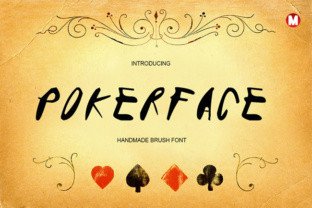
Pokerface is not a generic script or a mechanical digital brush. It is created entirely by hand, which means every character carries slight variations in stroke width, pressure, and angle. This imperfection is intentional. Unlike a vector-based script that can feel sterile, Pokerface offers a tactile quality that mimics the physical act of writing with a brush and ink. For designers and business owners who want to communicate warmth, creativity, or a rugged sense of individuality, that human touch can be a major benefit.
The font includes a full set of uppercase and lowercase letters, numerals, punctuation, and often multilingual support, depending on the version you acquire. Its characters tend to be bold, with generous ascenders and descenders that give an energetic, upright stance. Because it is a brush font, the contrast between thick and thin strokes is pronounced, which adds visual rhythm but also requires careful spacing. In practice, most users find Pokerface works well in display sizes — such as headings, short quotes, or logo elements — rather than extended body copy.
Comparing Pokerface with Alternative Font Categories
No single typeface covers every need. To evaluate Pokerface fairly, it helps to compare it with broader categories you might consider: other brush scripts, hand-drawn sans serifs, refined calligraphy fonts, and clean modern sans serifs. Each category has different strengths and tradeoffs.
- Brush Scripts vs. Pokerface: Many brush scripts are based on that same handmade aesthetic, but they vary in roughness. Some are highly consistent, almost like a digital brush stroke. Pokerface tends to sit at the rougher, more organic end. If you need a brush font that feels spontaneous, Pokerface is a strong candidate. If you need something more uniform for readability at smaller sizes, a more polished brush script might be better.
- Hand-drawn Sans Serifs: These fonts also offer a handcrafted look but without the brush stroke variation. They often have simpler letterforms and work well for casual branding. Pokerface has more flair and movement, which can be a distraction if your project calls for a quieter, more neutral appearance. For a modern coffee shop menu, a hand-drawn sans might be more legible; for an artistic poster, Pokerface brings more character.
- Refined Calligraphy Fonts: Calligraphy typefaces are often based on traditional penmanship and are more structured. They can be elegant, flowing, and formal. Pokerface is deliberately less refined — it is rougher, more informal, and more playful. If you are designing wedding invitations for a rustic or outdoor theme, Pokerface may fit perfectly. For a black-tie event, a more structured calligraphy font might convey the formality better.
- Clean Modern Sans Serifs: These are the workhorses of design: neutral, highly legible, and scalable. Pokerface is the opposite in many ways. It demands attention and sets a specific mood. If your brand needs to appear serious, technical, or minimalist, a clean sans serif will serve you better. But if you want personality and a human connection, Pokerface offers a shortcut to that feeling.
These comparisons show that Pokerface is neither a universal solution nor an inferior alternative. It is a tool with a clear personality, and the key is matching that personality to your project’s tone.
Strengths and Tradeoffs of Pokerface in Realistic Use Cases
To understand where Pokerface truly shines, consider specific scenarios where the handmade quality is an advantage.
- Invitations and Greeting Cards: A handwritten feel is almost expected for many invitation styles — save the dates, birthday parties, baby showers, or casual celebrations. Pokerface can make each letter look as if it were brushed on the page. However, if the invitation has a large amount of text, such as directions or a full schedule, the readability of a brush font may drop. In those cases, using Pokerface for the headline and pairing it with a simple serif or sans for the details works well.
- Branding Materials and Business Cards: For a boutique brand, a creative agency, an artisanal product, or a personal project, Pokerface can convey a unique identity. It says “we are independent, creative, and hands-on.” On a business card, the font is used sparingly — usually for the name or a tagline — so the bold strokes make a memorable impression. The tradeoff is that if the brand expands and needs consistent digital presence across multiple media, Pokerface may be difficult to use in small sizes or on screens. That does not make it a bad choice, but it does mean you should consider whether the font will support your brand’s long-term evolution.
- Quotes and Posters: This is arguably Pokerface’s strongest area. A short, impactful statement set in a large size benefits from the font’s energy and texture. The slight irregularities in letter spacing can be part of the aesthetic. For posters that are meant to be an experience — not just information — Pokerface helps create a visual focal point. The limitation again is legibility: if the quote includes unusual words or a long phrase at a small size, readers may struggle. Testing at your intended output size is essential.
- Social Media Graphics and Digital Use: While Pokerface is primarily a display font, it can be used for social media posts, especially on platforms where visual impact matters (Instagram, Pinterest). The handmade look stands out against the sea of clean digital type. Keep in mind that on low-resolution screens, the fine details of brush strokes may blur. For web headers or images, ensure the font is used large enough to preserve its character.
Beyond these use cases, one general tradeoff applies: file size and compatibility. Handmade brush fonts like Pokerface often include many glyphs and alternative characters, which can increase file size but also give you customization options. When used in standard desktop publishing software, they work without issues, but if you plan to embed the font on a website, be aware that it may slow page load times if not optimized. Similarly, some web font services may not host this specific style, so you would need to include it manually. These are practical considerations but not deal-breakers for most projects.
When Pokerface May Be the Right Choice
You might choose Pokerface if your project requires a strong, informal, and artistic voice. It is well-suited when you want to evoke craftsmanship, creativity, or a slightly rebellious spirit. The font works especially well in short bursts — a logo, a single word, a brief headline — where each letter can breathe. If your audience is adults who appreciate handmade aesthetics (for example, a local artisan market, a craft brewery, a tattoo studio, or a children’s book cover), Pokerface can feel authentic and approachable.
It is also a solid option when you want to break away from the uniformity of stock fonts. In a landscape where many brands use the same few typefaces, a distinctive handmade font gives you an edge. The absence of perfect geometry is actually a strength in contexts where perfection feels impersonal.
When Another Option May Be a Better Fit
There are situations where Pokerface is not the ideal solution. If your project requires extensive body text — anything longer than a sentence or two in a small size — a brush font like Pokerface will likely reduce readability. For corporate communications, financial documents, scientific papers, or legal notices, the font’s informal tone would clash with the need for authority and clarity. Similarly, if you are designing for very small sizes, such as a website footer, the brush strokes may become muddy or indistinct.
Another scenario: if your brand needs to convey luxury, precision, or restraint, Pokerface might feel too raw. A refined serif or a clean sans serif would align better with high-end fashion, jewelry, or luxury hospitality. Likewise, if your project is part of a larger system that requires consistency across many media — from billboards to mobile apps — you will likely need a typeface that scales smoothly and remains legible at all sizes. Pokerface can be part of that system as a display accent, but it should not be the sole typeface.
Factors to Consider When Evaluating Pokerface for Your Project
Before committing to Pokerface, weigh the following decision factors:
- Tone alignment: Does the font’s handmade, organic mood match the emotional message of your project? If you are unsure, create a mockup with the actual text. Seeing it in context is better than guessing.
- Readability vs. character: How much text do you need to set? If it is a few words, character can take priority. If it is a paragraph, prioritize readability and use Pokerface only for emphasis.
- Pairing potential: A font rarely works alone. Consider how Pokerface pairs with a complementary sans serif or serif for secondary text. A common formula is a bold brush headline with a clean, neutral body font. Test that combination before finalizing.
- Licensing and file type: Ensure you have the appropriate license for your use case (commercial, web, app). Handmade fonts sometimes have restrictions on embedding or redistribution. Check the end user license agreement for the specific version you download.
- Platform consistency: If your design will appear both in print and on screen, test Pokerface at the exact sizes and resolutions you will use. What looks striking in a high-resolution print may lose detail on a mobile screen.
- Alternatives within the same category: There are many handmade brush fonts available, each with a unique personality. If Pokerface does not offer the exact stroke shape or weight you want, consider exploring other options in the same genre. The decision is not binary — you may find a better match.
Practical Comparisons with Similar Approaches
To give you a concrete sense of how Pokerface compares, imagine two distinct design briefs. First, a poster for a rock music festival. Using Pokerface in large letters creates an immediate raw, energetic feel. The uneven brush strokes echo the rawness of live music. If you instead used a clean sans serif, the poster might look too polished, like a corporate event. The brush font wins because the tone matches the audience’s expectations.
Second, a brochure for a health insurance provider. Even if the company wants to appear “friendly,” the content includes detailed policy information and dates. Pokerface used for body text would be hard to read, and the informal tone could undermine trust. A better choice is to use a legible serif for the text and perhaps incorporate Pokerface just in the headline or a call-out box — but even then, the mismatch in formality might feel off. In this case, a more neutral display font or a simple sans serif would be more appropriate.
These examples highlight that the same font can be perfect in one context and problematic in another. The skill is in identifying the context and matching it with the appropriate typeface.
Making an Informed Decision Without Hype
Pokerface is not a magic solution that will make every design look better. It is a distinctive tool among many. Its handmade quality is both its greatest strength and its most significant limitation. For designers who value authenticity and emotional connection, it offers something that many digital fonts cannot replicate. For those who prioritize consistency, scalability, and neutrality, it will feel too narrow in application.
The best approach is to evaluate Pokerface as you would any other resource: by honestly assessing your project’s needs, testing it in actual mockups, and pairing it thoughtfully. If you determine that a handmade brush font aligns with your goals, Pokerface is a solid candidate to consider. If you find that your project requires a different tone or greater flexibility, there is no shortage of alternatives that will serve you well. The final choice should always be based on what works best for your audience and your message, not on the popularity of the font itself.
By taking the time to compare, test, and weigh tradeoffs, you can make a decision that feels right for your specific situation. That is the mark of an informed designer — and it is exactly the kind of care your audience will appreciate.